Online · Sofia · Bulgaria

Online Robotics Classes for Kids in Sofia

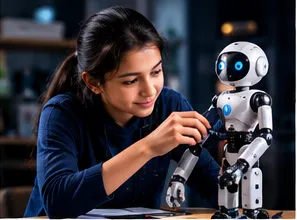
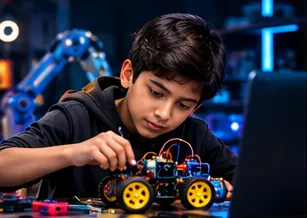
Online robotics classes for kids in Sofia help local and international students explore circuit logic, motor control, sensor processing and systematic debugging in clear English—from home, without inventing a private campus.

Online robotics Sofia

Chapter 106 – Decision Tree Depth and Overfitting Explained for Beginners

1. Introduction: Tree Depth vs Overfitting

Maximum depth (max_depth) is a key hyperparameter. Unrestricted depth tends to memorize training noise ("ratta") and hurt test performance. Controlling depth improves generalization.

  • Shallow tree — may underfit
  • Very deep tree — high train accuracy, weaker test accuracy (overfitting)
  • Controlled depth — small train–test gap, better generalization

2. Experimental Setup

import numpy as np
import matplotlib.pyplot as plt
from sklearn.datasets import make_moons
from sklearn.model_selection import train_test_split
from sklearn.tree import DecisionTreeClassifier
from sklearn.metrics import accuracy_score

make_moons creates a non-linear two-class problem with overlapping half-moons—useful for probing depth limits.

3. Dataset and Train–Test Split

X, y = make_moons(n_samples=500, noise=0.25, random_state=42)
X_train, X_test, y_train, y_test = train_test_split(
    X, y, test_size=0.3, random_state=42
)
print(f"Training Samples: {len(X_train)} | Testing Samples: {len(X_test)}")

500 samples, 25% noise, 70/30 split (350 train / 150 test). Test data stays hidden during training.

4. Evaluating Depths 1–15

depths = list(range(1, 16))
train_accuracies = []
test_accuracies = []

for d in depths:
    clf = DecisionTreeClassifier(max_depth=d, random_state=42)
    clf.fit(X_train, y_train)
    train_accuracies.append(accuracy_score(y_train, clf.predict(X_train)))
    test_accuracies.append(accuracy_score(y_test, clf.predict(X_test)))

5. Plotting Train vs Test Accuracy

plt.figure(figsize=(10, 6))
plt.plot(depths, train_accuracies, label="Training Accuracy", marker="o", color="blue")
plt.plot(depths, test_accuracies, label="Testing Accuracy", marker="s", color="red")
plt.xlabel("Max Tree Depth (max_depth)")
plt.ylabel("Accuracy Score")
plt.title("Decision Tree Depth vs. Overfitting Analysis")
plt.ylim(0.80, 1.00)
plt.grid(True, linestyle="--", alpha=0.6)
plt.legend()
plt.show()
  • Depth 1 — underfit (~0.83 train / ~0.82 test)
  • Depth 2 — both curves rise (~0.925 / ~0.90)
  • Depth 6 — small gap, strong generalization (optimal in this run)
  • Depths 7–15 — train → ~100%, test drops; gap ~10% (overfitting)

6. Finding Optimal Depth in Code

best_depth_idx = np.argmax(test_accuracies)
best_depth = depths[best_depth_idx]
best_test_acc = test_accuracies[best_depth_idx]
print(f"Optimal Tree Depth: {best_depth}")
print(f"Peak Testing Accuracy: {best_test_acc * 100:.2f}%")

In this experiment, max_depth = 6 maximized test accuracy with a minimal train–test gap.

7. Deployment Checklist

  • Track train and test accuracy together
  • Watch for curve divergence (onset of overfitting)
  • Stop increasing depth once lines pull apart; prefer the last depth where they stayed close

Lesson Q&A

Deeper trees fit training data almost perfectly but tend to memorize noise. Test accuracy often falls, widening the train–test gap—classic overfitting.

make_moons gives overlapping moon-shaped classes and a non-linear boundary. Configuration: 500 samples, noise=0.25, random_state=42; 70% train (350) / 30% test (150), test held out for unbiased evaluation.

Choose the depth where test accuracy peaks and the train–test gap stays small. Divergence (train rising, test falling) marks overfitting. Here, depth 6 was optimal before the gap grew at depth 7+.

What children can learn

Enquire about online robotics classes for kids in Sofia

WhatsApp +92 322 421 7059

AI and Robotics Club | The 100 Mission AI & Robotics Hero Journey

100 Mission playlist · WhatsApp community · Saturday live 12–1 PM GMT

Recommended self-paced course for parents & educators

Robotics Miniature Modeling for Kids on Udemy — a structured option families can explore alongside live mentoring.

Disclosure: This page contains affiliate links. We may earn from qualifying purchases at no extra cost to you. Links are intended for parents and educators, not as marketing directed at young children.

Balkan Tech Hub: Online Robotics and Automation Logic for Kids in Sofia

Sofia’s growing technology community pairs well with practical STEM learning delivered in English. Online robotics classes for kids in Sofia introduce the core sense → decide → act loop: a sensor reads the environment, control logic chooses a response, and motors or lights carry out the action. Students practice this cycle on software simulators first so ideas stay clear before any optional beginner hardware is introduced under adult supervision.

EET-friendly evening and weekend windows can be discussed on enquiry; this page does not invent a fixed timetable or a private Sofia campus. Core skills include circuit logic, motor control ideas, sensor signal processing and systematic debugging. Parents support learning best by asking guiding questions rather than completing projects for the child. Supervise batteries, wires and small components whenever physical kits are used.

Contact WhatsApp +92 322 4217059 or support@aiandroboticsclub.com to discuss suitability. The free 100 Mission playlist and Saturday live support sessions (12–1 PM GMT) extend practice without pressure. Naming Sofia helps families find relevant online options; it does not invent local labs, guaranteed outcomes or inflated skill claims. Progress is measured by understanding and completed mini-projects, not by marketing promises.

Parent guidance

Ask your child to explain one idea in their own words. Prefer guiding questions over completing the work for them. Supervise online accounts and any hardware. We do not invent prices, campus addresses or guaranteed academic outcomes.

How to enquire

Contact WhatsApp +92 322 4217059 or support@aiandroboticsclub.com. Primary delivery: interactive online learning in English with EET-friendly options on enquiry.


Frequently asked questions

Are robotics classes in Sofia taught in English?

Yes, instruction is in clear English, suitable for local and international students in Sofia.

What core concepts are taught in robotics classes?

Circuit logic, motor control, sensor signal processing, and debugging.

How can parents in Sofia contact customer support?

Email us at support@aiandroboticsclub.com or message our WhatsApp helpline.

Explore related learning

PlovdivPython · Plovdiv VarnaAI · Varna ZagrebRobotics · Zagreb

Related pages