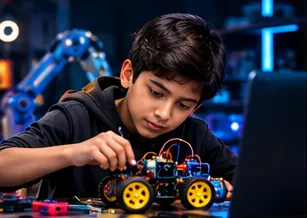
Online robotics classes for kids in Athens help local and international students explore sensors, control loops and systematic debugging in clear English—from home, without inventing a private campus.
Chapter 136 – Hierarchical Clustering with Scikit-Learn (Part 1)
1. Agglomerative Flow
Agglomerative clustering is unsupervised and bottom-up: every sample starts alone, closest pairs merge until n_clusters is reached. No target labels are used—only distances in the feature matrix.
2. Core Hyperparameters
Parameter
Role
n_clusters
Final number of groups (e.g. 3)
metric / affinity
Distance (euclidean, manhattan, …)
linkage
ward (min variance), complete (max pair), average (mean pair)
3. Iris Dataset
150 rows × 4 features (sepal/petal length & width in cm). Same units across columns → no StandardScaler required before distance-based clustering.
4. Implementation Pipeline
import pandas as pd
from sklearn.datasets import load_iris
from sklearn.cluster import AgglomerativeClustering

iris = load_iris()
X = pd.DataFrame(iris.data, columns=iris.feature_names)
print(X.shape)  # (150, 4)

hc = AgglomerativeClustering(n_clusters=3, linkage="ward")
labels = hc.fit_predict(X)
X["cluster"] = labels
print(X["cluster"].value_counts())
5. Typical Cluster Counts (Ward, k=3)
Cluster 0: 64 samples
Cluster 1: 50 samples
Cluster 2: 36 samples
IDs are arbitrary (0/1/2). Domain experts can later map them to species names.
It starts with one cluster per sample and merges closest pairs until n_clusters is met. Key settings: n_clusters, distance metric, and linkage (ward / complete / average).
All four features are in centimeters on similar scales, so no single column dominates Euclidean (or similar) distances. Scaling is optional here, unlike mixed-unit datasets.
Typically about 64, 50, and 36 samples in clusters 0–2. Labels are arbitrary integers; humans assign meaningful names afterward using domain knowledge.
What children can learn
Sensor input processing
Control logic loops
Motor speed management ideas
Systematic debugging
Enquire about online robotics classes for kids in Athens
Disclosure: This page contains affiliate links. We may earn from qualifying purchases at no extra cost to you. Links are intended for parents and educators, not as marketing directed at young children.
Socratic Logic to Modern Code: Robotics Engineering for Kids in Athens
Athens families often want practical STEM in English. Online robotics classes for kids in Athens teach sense → decide → act on a simulator first, with optional beginner hardware later under adult supervision. Logic before luxury kits. Mentors guide accessible tools without forced purchases.
EET/EEST evening and weekend windows can be discussed on enquiry; this page does not invent a fixed timetable or a private Athens campus. Core skills include sensor processing, control loops, motor ideas and systematic debugging. Parents support with guiding questions. Supervise batteries and wires; keep accounts under adult control.
Contact WhatsApp +92 322 4217059 or support@aiandroboticsclub.com. Free 100 Mission playlist and Saturday live support (12–1 PM GMT) extend practice. Naming Athens helps search discovery; it does not invent local labs or guaranteed outcomes.
Frequently asked questions
Are classes in Athens taught in English?
Yes, sessions are conducted in clear, accessible English, ideal for international and local students in Athens.
What core robotics concepts are covered?
Sensor input processing, control logic loops, motor speed management, and systematic debugging.
How can parents in Athens get in touch with support?
Email us at support@aiandroboticsclub.com or send a message on WhatsApp.