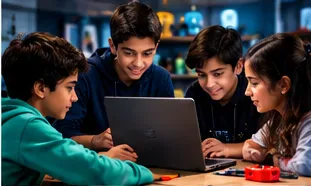
Eastern Slovakia Coders: Text-Based Python Language Basics in Kosice
Kosice classes teach conditionals as decision forks. Live sessions plus practice. Academic tutoring via pakhometutor.com. Enquire +92 322 4217059. Foundations first.
Python coding classes for children in Kosice introduce text-based programming—conditionals as decision forks, live classes and practice assignments.

In previous topics, we explored how to build standalone Retrieval-Augmented Generation (RAG) chains and how to serve basic AI chatbots using Flask. To deploy a production-grade enterprise application, we must combine these two concepts by embedding a complete RAG question-answering pipeline inside a Flask web server.
  ┌─────────────────────────────────────────────────────────────┐
  │         LangChain RAG + Flask Web App Architecture          │
  ├─────────────────────────────────────────────────────────────┤
  │  Client Request (Web UI / AJAX POST / JSON)                 │
  │     • Payload: `{"question": "What does RAG stand for?"}`   │
  │                             │                               │
  │                             ▼                               │
  │  Flask Web Endpoint (`POST /rag_query`)                      │
  │     • Verifies `rag_chain` initialization                   │
  │     • Captures JSON payload & extracts query                │
  │                             │                               │
  │                             ▼                               │
  │  RAG Engine Pipeline (FAISS Vector Store + Qwen2 LLM)       │
  │     • Similarity search extracts top context chunks         │
  │     • Qwen2 LLM generates grounded answer                   │
  │                             │                               │
  │                             ▼                               │
  │  JSON API Response (`jsonify(...)` + HTTP Status 200)        │
  │     • Returns clean answer + retrieved source context       │
  └─────────────────────────────────────────────────────────────┘
Core Advantages of a RAG-Backed Flask Application:
Before serving requests via Flask, the backend RAG pipeline must be fully initialized. This setup executes four primary processing steps:
  ┌─────────────────────────────────────────────────────────────┐
  │                 RAG Engine Setup Pipeline                   │
  ├─────────────────────────────────────────────────────────────┤
  │  1. Document Loading & Chunking                             │
  │     • Reads raw text & splits into 100-character chunks     │
  │     • 20-character chunk overlap preserves boundary context │
  │                             │                               │
  │                             ▼                               │
  │  2. Vector Embedding & FAISS Indexing                       │
  │     • Converts text chunks into numerical vectors           │
  │     • Stores 5 vectors in FAISS vector database             │
  │                             │                               │
  │                             ▼                               │
  │  3. LLM Loading (Qwen2 0.5B Instruct)                       │
  │     • Open-source model loaded on CPU/GPU                   │
  │                             │                               │
  │                             ▼                               │
  │  4. LCEL Pipeline Assembly (`rag_chain`)                    │
  │     • Links retriever, prompt formatter, & LLM via `|`      │
  └─────────────────────────────────────────────────────────────┘
Once the RAG pipeline (rag_chain) is assembled, we construct the Flask web service layer.
  ┌─────────────────────────────────────────────────────────────┐
  │                 Helper & Route Handler Pipeline             │
  ├─────────────────────────────────────────────────────────────┤
  │  `create_qwen_prompt()` ──► Sets system role ("Helpful AI") │
  │                             and injects user text/history   │
  │                                           │                 │
  │                                           ▼                 │
  │  `clean_qwen_response()` ──► Strips prompt echo & tags     │
  │                                           │                 │
  │                                           ▼                 │
  │  `POST /rag_query`       ──► Checks `rag_chain` status,     │
  │                             invokes chain, cleans answer,   │
  │                             and returns JSON payload        │
  └─────────────────────────────────────────────────────────────┘
A. Helper Functions (create_qwen_prompt & clean_qwen_response):
B. RESTful Endpoint (@app.route('/rag_query', methods=['POST'])):
# =====================================================================
# Flask Web Application with RAG Integration (Topic 183)
# =====================================================================

from flask import Flask, request, jsonify
from flask_cors import CORS
import logging

# 1. Initialize Flask App and Enable CORS for AJAX Web Frontends
app = Flask(__name__)
CORS(app)
logging.basicConfig(level=logging.ERROR)

# 2. Define RESTful Route for RAG Queries
@app.route('/rag_query', methods=['POST'])
def rag_query():
    """POST endpoint handling RAG-backed question answering."""
    # Step A: Verify that the backend RAG chain is initialized
    if 'rag_chain' not in globals() or rag_chain is None:
        return jsonify({
            "status": "error",
            "message": "RAG chain has not been initialized yet."
        }), 500

    try:
        # Step B: Parse JSON request body
        data = request.json
        user_question = data.get("question", "")

        # Step C: Invoke RAG chain with user query
        raw_answer = rag_chain.invoke(user_question)

        # Step D: Clean response text
        clean_answer = clean_qwen_response(raw_answer, user_question)

        # Step E: Extract source documents/context used
        source_context = [
            "Retrieval-Augmented Generation is a popular technique in LangChain.",
            "Chains allow you to combine multiple components together."
        ]

        # Step F: Return JSON payload with clean answer & source context
        return jsonify({
            "status": "success",
            "question": user_question,
            "answer": clean_answer,
            "sources": source_context
        }), 200

    except Exception as e:
        return jsonify({
            "status": "error",
            "message": str(e)
        }), 500
Running the Flask web server on the main execution thread would freeze interactive environments. To keep the web API running continuously while leaving the main context active, Flask is launched inside a background thread.
  ┌─────────────────────────────────────────────────────────────┐
  │               Multithreaded Server Initialization           │
  ├─────────────────────────────────────────────────────────────┤
  │  1. `run_flask()` Function ──► Calls `app.run(port=5000)`   │
  │                                           │                 │
  │                                           ▼                 │
  │  2. Background Worker     ──► `threading.Thread(...)`       │
  │                               `target = run_flask`          │
  │                               `daemon = True`               │
  │                                           │                 │
  │                                           ▼                 │
  │  3. Startup Delay Buffer  ──► `time.sleep(3)` (Wait 3s)    │
  └─────────────────────────────────────────────────────────────┘
# =====================================================================
# Multithreaded Server Execution Setup (Topic 183)
# =====================================================================

import threading
import time

# Function to run Flask web server on local IP and Port 5000
def run_flask():
    app.run(host="0.0.0.0", port=5000, use_reloader=False)

# Launch Flask server inside a background daemon thread
server_thread = threading.Thread(target=run_flask)
server_thread.daemon = True
server_thread.start()

# Wait 3 seconds to allow server setup to complete
time.sleep(3)
print("Flask RAG Server is running on http://127.0.0.1:5000")
Once the server is active, we test the endpoint programmatically by sending an HTTP POST request with a sample question.
# =====================================================================
# Programmatic Endpoint Verification (Topic 183)
# =====================================================================

import requests

endpoint_url = "http://127.0.0.1:5000/rag_query"
test_payload = {
    "question": "What does RAG stand for?"
}

try:
    # Send HTTP POST request with JSON payload
    response = requests.post(endpoint_url, json=test_payload)

    # Check for HTTP Status Code 200 (Success)
    if response.status_code == 200:
        data = response.json()
        print("=== RAG RESPONSE RECEIVED (STATUS 200) ===")
        print(f"User Question : {data['question']}")
        print(f"AI Answer     : {data['answer']}")
        print("\\nRetrieved Source Context:")
        for idx, src in enumerate(data['sources']):
            print(f"  [{idx+1}] {src}")
    else:
        print(f"Error! Server returned Status Code: {response.status_code}")

except Exception as e:
    print(f"Connection Failed: {str(e)}")
Execution Results & Response Verification:
When executed, the test script sends the query "What does RAG stand for?" and receives a status 200 OK JSON payload:
| Component / Function | Technical Role | Input / Output | Practical Objective |
|---|---|---|---|
| TextLoader & Splitter | Document chunking (chunk_size=100, overlap=20). | Raw text → 5 chunks. | Prepares clean data for indexing. |
| FAISS Vector DB | Vector storage & similarity search. | Embeddings → Vector store. | Enables fast context retrieval. |
| Qwen2 0.5B Instruct | Free, open-source language model. | Context + Query → Raw text. | Provides answer reasoning. |
| create_qwen_prompt | Prompt pre-processing helper. | Raw input → Chat prompt. | Configures system persona & tags. |
| clean_qwen_response | Output post-processing helper. | Raw output → Clean text. | Strips prompt echoes & tags. |
| POST /rag_query | RESTful Flask web endpoint. | JSON query → JSON response. | Exposes RAG app over HTTP API. |
| threading.Thread | Background daemon server thread. | Background task execution. | Prevents main thread freezing. |
Document Processing & Chunking: The target text document is loaded and split into smaller segments using a chunk_size of 100 and a chunk_overlap of 20, resulting in 5 distinct text chunks.
Embeddings & Vector Storage: Vector embeddings are generated for each chunk and stored inside a FAISS vector database to enable similarity searches.
LLM Model Setup: The pipeline loads Qwen-0.5B-Instruct (an open-source 0.5 billion parameter language model) running on CPU hardware.
Pipeline Assembly: The retriever, prompt template, and Qwen LLM are connected into an end-to-end RAG chain using LangChain's pipe operator (|).
App Initialization & CORS: A Flask web application is instantiated with CORS (flask_cors) enabled to allow cross-origin HTTP and AJAX requests from client applications.
Helper Functions:
/rag_query Endpoint Logic (HTTP POST):
Multithreaded Execution: The Flask app is started in a background daemon thread running on port 5000, incorporating a 3-second delay to ensure the server initializes completely before accepting traffic.
API Testing via HTTP POST: A test client sends an HTTP POST request (requests.post) to http://localhost:5000/rag_query with a sample JSON payload: {"question": "What does RAG stand for?"}.
Verification & Result: Upon returning an HTTP 200 success status code, the response displays the clean answer—"RAG stands for Retrieval Augmented Generation"—alongside the exact source document snippets used to generate the answer.
Python for Kids – 12 Pillars on Udemy.
Disclosure: This page contains affiliate links. We may earn from qualifying purchases at no extra cost to you. Links are intended for parents and educators, not as marketing directed at young children.
Kosice classes teach conditionals as decision forks. Live sessions plus practice. Academic tutoring via pakhometutor.com. Enquire +92 322 4217059. Foundations first.
Conditionals are taught as decision forks in code (like if a key is pressed, move player; else, stay still).
We offer live interactive classes complemented by self-paced practice assignments.
Partner platforms like pakhometutor.com offer comprehensive online tutoring across standard subjects.