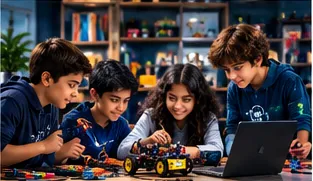
AI courses for kids in Ostrava introduce how training data shapes models, how bias can appear, and how to evaluate AI answers critically under parent supervision.
Chapter 116 – SVM Margin Explained
1. Goal: Maximize the Margin
SVM places a hyperplane so that the gap (margin) to the nearest points of each class is as large as possible. That gap is a safety zone that improves generalization on new data.
2. Boundary, Support Vectors, and Geometry
Hyperplane (2D): line \(w \cdot x + b = 0\). One side → Class 0; other side → Class 1.
Support vectors: the closest points to that line. Only they fix the final boundary; other points can move without changing it.
Margin: \(\frac{1}{\|w\|}\) — distance from the decision line to the parallel margin lines at \(w \cdot x + b = \pm 1\).
3. Hard vs Soft Margin (C)
High C (e.g. 10): hard margin — penalizes violations heavily; tight fit around support vectors.
Low C (e.g. 0.1): soft margin — allows a few violations for a wider, more robust gap.
4. Python Sketch (Linear SVC + Plot)
from sklearn.svm import SVC
from sklearn.datasets import make_blobs
import numpy as np
import matplotlib.pyplot as plt

X, y = make_blobs(n_samples=100, centers=2, cluster_std=1.1, random_state=42)
svm = SVC(kernel='linear', C=10)
svm.fit(X, y)

w, b = svm.coef_[0], svm.intercept_[0]
margin = 1.0 / np.linalg.norm(w)
print("Margin:", margin, "| Support vectors:", len(svm.support_vectors_))

# Plot decision line and parallel margins, highlight support vectors
Typical run: a few support vectors (often one per class on clean blobs), margin width from \(1/\|w\|\), decision line and two parallel dotted margins.
5. Parameter Cheat Sheet
Item
Role
C
Hard vs soft margin trade-off
kernel='linear'
Linear separator
svm.coef_ / intercept_
\(w\) and \(b\)
1 / ||w||
Margin width
support_vectors_
Points that define the boundary
Lesson Q&A
Maximize the margin — the distance from the hyperplane to the nearest points (support vectors). Mathematically: Margin = 1 / ||w||. Wider margins usually generalize better.
They are the closest points to the boundary and fully determine it. Points farther away can be moved or removed without changing the decision surface.
High C → hard margin (few or no violations). Low C → soft margin (some violations allowed for a wider gap). Use SVC(kernel='linear', C=...).
Disclosure: This page contains affiliate links. We may earn from qualifying purchases at no extra cost to you. Links are intended for parents and educators, not as marketing directed at young children.
Artificial Intelligence Basics: Data Classification and Training Models in Ostrava
Ostrava families exploring AI need ethics alongside tools. Classification demos and supervised platforms keep learning age-appropriate. Never share personal data with bots. Standard computers suffice. Progress via project showcases. Enquire support@aiandroboticsclub.com or WhatsApp +92 322 4217059.
Frequently asked questions
How do children in Ostrava learn about AI ethics?
We teach kids to recognize algorithmic bias, protect digital privacy, and evaluate AI answers critically.
What computer hardware is required for online AI lessons?
A standard desktop or laptop computer with a modern web browser is sufficient.
Can parents track their child's learning progress?
Yes, mentors provide project feedback and students showcase working models at module end.