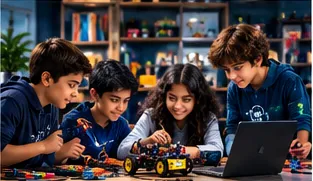
Online robotics classes for kids in Prague help local and expat families explore sensors, motors and control logic from home—without inventing a campus on every street.
Chapter 117 – The Kernel Trick Explained
1. When Linear Separation Fails
Many real datasets are not linearly separable (e.g. one class forming a ring around another). A straight line or flat hyperplane cannot split them cleanly. The kernel trick maps data into a higher-dimensional space where a linear boundary works again—without building that space explicitly.
2. Inner Products Instead of Explicit Mapping
A kernel function \(K(x_i, x_j) = \langle \Phi(x_i), \Phi(x_j) \rangle\) evaluates similarity in the feature space via inner products. That avoids computing full high-dimensional coordinates and keeps computation practical.
3. Common Kernels
Kernel
Formula
Use
Linear
\(x_i \cdot x_j\)
Already linearly separable data
Polynomial
\((x_i \cdot x_j + e)^d\)
Moderate curved boundaries
RBF (Gaussian)
\(\exp(-\gamma \|x_i - x_j\|^2)\)
Complex non-linear data (default in practice)
4. Circles Demo (Scikit-Learn)
from sklearn.datasets import make_circles
from sklearn.svm import SVC
from sklearn.metrics import accuracy_score

X, y = make_circles(n_samples=200, factor=0.3, noise=0.05, random_state=42)

for name, model in {
    'Linear': SVC(kernel='linear'),
    'Polynomial': SVC(kernel='poly', degree=3),
    'RBF': SVC(kernel='rbf', gamma=1.5)
}.items():
    model.fit(X, y)
    print(name, accuracy_score(y, model.predict(X)) * 100)
Typical result on concentric circles: Linear ~69%, Poly ~71%, RBF ~100% — RBF forms a circular boundary that separates inner and outer classes.
5. Takeaway
Prefer RBF when boundaries are clearly non-linear; use linear when data is already separable with a line/plane. Polynomial sits in between for moderate curves.
Lesson Q&A
It maps data into a higher-dimensional space where classes become linearly separable, but does so by computing inner products \(K(x_i, x_j)\) instead of explicitly calculating all new coordinates.
Linear: \(x_i \cdot x_j\). Polynomial: \((x_i \cdot x_j + e)^d\). RBF: \(\exp(-\gamma \|x_i - x_j\|^2)\). Linear for simple splits; poly for moderate curves; RBF for complex non-linear data.
About 69% (linear), 71% (poly degree 3), and 100% (RBF with gamma=1.5). Only RBF fully separated the concentric classes with a circular boundary.
What children can learn
Sensors, motors and control loops
Input-output signal ideas
Systematic debugging
Simulators first, optional hardware when ready
Enquire about online robotics classes for kids in Prague
Disclosure: This page contains affiliate links. We may earn from qualifying purchases at no extra cost to you. Links are intended for parents and educators, not as marketing directed at young children.
Engineering in the Golden City: Robotics and Logic Foundations in Prague
Prague’s international schools and bilingual households often want practical STEM in English. Online robotics classes for kids in Prague teach sense → decide → act—on a simulator first, and optionally with beginner hardware later.
Logic before luxury kits. Mentors guide accessible tools without forced purchases. English delivery suits local and expat families. CET evening and weekend windows can be discussed; this page does not invent a fixed timetable or a private Prague campus.
The 100-Mission Hero Journey offers a structured path from Explorer to Champion for families who want ongoing practice. Contact WhatsApp +92 322 4217059 or support@aiandroboticsclub.com. Naming Prague helps search discovery; it does not invent local labs.
Parent guidance
Ask your child to explain one idea in their own words. Prefer guiding questions over completing the work for them. Supervise online accounts and any hardware.