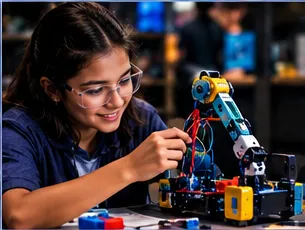
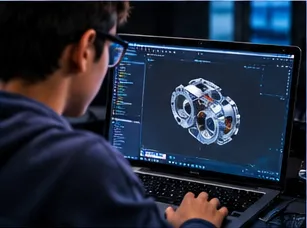
AI courses for kids in Marseille introduce pattern recognition, classification and responsible use of intelligent tools—so children understand how predictions are made, not only how to chat with an app.
Chapter 125 – Naive Bayes Independence Assumption
1. The Core Feature Independence Assumption
Naive Bayes is built on Bayes' Theorem. Its defining trait is the assumption that every input feature is independent of the others given the class label, so each feature contributes separately to the class decision.
2. Real-World Interdependence vs. the Naive Assumption
In real data, features usually interact (the "Butterfly Effect" idea: small changes can cascade). Naive Bayes still treats features as independent. That trade-off ignores weak interactions so joint probabilities become a simple product of individual conditionals—much faster to train and predict.
from sklearn.datasets import load_breast_cancer
from sklearn.model_selection import train_test_split
from sklearn.naive_bayes import GaussianNB
from sklearn.metrics import accuracy_score

cancer = load_breast_cancer()
X, y = cancer.data, cancer.target
X_train, X_test, y_train, y_test = train_test_split(
    X, y, test_size=0.25, random_state=42)

gnb = GaussianNB()
gnb.fit(X_train, y_train)
y_pred = gnb.predict(X_test)
print(accuracy_score(y_test, y_pred) * 100)  # ~93.71%
Defaults: priors=None (learned from class counts), var_smoothing=1e-09 for numerical stability.
6. Inspecting Internals
class_prior_ — baseline class probabilities
theta_ — feature means per class
var_ — feature variances per class
Despite 30 correlated biological features, GaussianNB still reached about 93.71% test accuracy by modeling each feature as an independent Gaussian and multiplying the densities.
7. Summary
Aspect
Real world
Naive Bayes
Impact
Feature links
Interdependent
Independent
Ignores weak correlations
Joint probability
Heavy matrices
Product of singles
Fast math
Spam words
Correlated
Separate events
Simple product
Breast cancer (30 feats)
Correlated measures
Independent Gaussians
~93.71% accuracy
Lesson Q&A
It states that features are independent given the class. Real data is rarely like that, but the assumption lets the model multiply single-feature probabilities instead of building large joint tables, so training and prediction stay fast.
Even though those words often appear together, the model treats them as independent and multiplies P("Win" | Spam) × P("Prize" | Spam) to get the joint likelihood for spam.
About 93.71% on a 75/25 split. Inspected: class_prior_ (class base rates), theta_ (per-class feature means), and var_ (per-class feature variances).
What children can learn
Patterns, examples and simple classification ideas
Demystifying Machine Learning: Pattern Recognition Training for Young Learners in Marseille
Artificial intelligence is easy to treat as magic. AI courses for kids in Marseille aim for the opposite: show that systems learn from examples, make predictions, and can fail. Understanding those limits is part of digital citizenship.
Pattern recognition starts with familiar games—sorting shapes, spotting trends, grouping images. Classification assigns labels from features. Young learners do not need advanced mathematics to grasp that more examples can improve a model and that poor or biased examples can mislead it. Image recognition can be introduced conceptually: pixels as data, patterns as statistics, confidence as a score—not as certainty.
Responsible use is curriculum, not a footnote. Children learn not to share personal data with bots, to question confident-sounding answers, and to verify facts with trusted adults. Parents remain gatekeepers of accounts and devices. Prompt design is taught as a craft: clear questions, specific constraints, checking output against reality.
Illustrative projects might include pattern games or carefully supervised educational tools. Online platforms need age-appropriate settings. We do not claim every advanced research technique belongs in a beginner pathway. Distinguishing illustrative ideas from confirmed syllabus items keeps trust intact.
Marseille families searching for AI courses often want English clarity and honest outcomes. We do not promise careers, income or exam scores. We promise vocabulary and habits that help a child talk about AI critically. CET-friendly timing can be discussed for after-school and weekend slots via support@aiandroboticsclub.com or WhatsApp +92 322 4217059.
Even simple classifiers can inherit skewed examples. Mentors use age-appropriate stories about missing data. Generative tools can invent facts—students treat fluent text as a draft, not a verdict. The educational core is understanding, not dependency on any single brand of chatbot.
Frequently asked questions
What Artificial Intelligence concepts are introduced to kids in Marseille?
Students learn pattern recognition, data classification, image recognition principles, and basic machine learning logic.
Does this course cover safe online AI usage?
Yes, we place a strong emphasis on digital safety, responsible prompt engineering, and verifying AI-generated output.
Are live sessions scheduled conveniently for Central European Time (CET)?
Yes, class options are structured to align smoothly with after-school and weekend schedules in France.