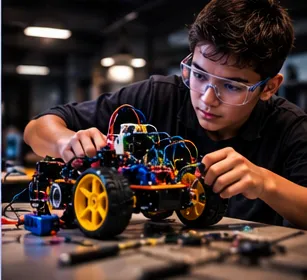
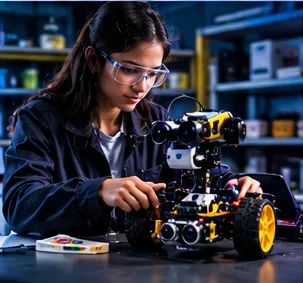
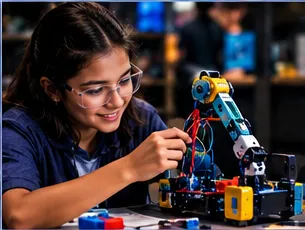
Computational thinking classes in Montpellier train decomposition, pattern recognition and debugging—core problem-solving habits useful in coding and beyond.
Chapter 128 – K-Means Clustering Explained
1. Supervised vs Unsupervised
Supervised models train on features X and labels y. Unsupervised models see only X and must discover structure. Clustering is a common unsupervised task: choose a number of groups K and let the algorithm form them.
2. Where Clustering Is Used
Customer segments for marketing
Unusual transaction groups in fraud analysis
Grouping similar articles or images
Browsing-behavior clusters for ads
3. Quality Without Labels
Without ground-truth labels, quality is judged by distances:
Within-cluster distance — minimize (points in a group stay tight)
K-Means partitions data into K clusters around moving centers called centroids. It is transparent and widely used as explainable unsupervised learning.
5. Four-Step Loop
Initialize K centroids (random or smarter schemes like k-means++)
Assign each point to the nearest centroid (often Euclidean distance)
Update each centroid to the mean of its assigned points
Repeat assign + update until stopping rules fire
6. When to Stop
Criterion
Meaning
Max iterations
Hit a fixed iteration budget
Centroid movement
Shifts fall below a small threshold ε
Stable assignments
No points change cluster between rounds
7. Strengths and Care
K-Means is fast and scales well, but results depend on starting centroids. Practical fixes: use k-means++ initialization, or run several random seeds and keep the run with the smallest within-cluster distance.
Lesson Q&A
Supervised learning uses X and y; unsupervised uses only X. Clustering quality is judged by minimizing within-cluster distance and maximizing between-cluster distance.
Initialize K centroids → assign points by nearest distance → move centroids to cluster means → repeat until a stop rule is met.
Stop on max iterations, tiny centroid movement, or unchanged assignments. Reduce start sensitivity with k-means++ and multi-run selection of the lowest within-cluster cost.
What children can learn
Breaking problems into smaller steps
Spotting patterns and reusable ideas
Debugging as structured investigation
Explaining solutions clearly to others
Enquire about computational thinking classes in Montpellier
AI and Robotics Club | The 100 Mission AI & Robotics Hero Journey
Decomposition and Debugging: Essential Computer Science Logic for Students in Montpellier
Computational thinking is not typing code quickly. Computational thinking classes in Montpellier emphasise four durable habits: decompose, notice patterns, design steps, evaluate results. Decomposition prevents overwhelm. Pattern recognition helps reuse ideas. Debugging is evaluation under pressure—form a hypothesis, test it, keep notes.
Activities may use coding tools or unplugged logic challenges depending on age and readiness. The constant is explanation quality: can the student teach the method back? Decomposition helps with multi-step maths; debugging habits help with revising written work. Families often notice side benefits when children pause to plan before rushing.
Montpellier families seeking English-medium cognitive skills online can enquire without expecting invented campus claims. WhatsApp +92 322 4217059 and support@aiandroboticsclub.com remain the verified channels. Tools change; thinking skills remain. Pairing these habits with robotics or Python later is natural—but thinking first keeps syntax from becoming empty ritual.
Computational thinking classes in Montpellier exist to make problem-solving teachable, visible and calm—useful whether or not a family later enrols in a longer coding pathway.
Frequently asked questions
What is computational thinking in simple terms?
It is a problem-solving approach: break the problem down, notice patterns, design steps and test them carefully.
Does this require a powerful computer?
No—a standard home computer or laptop with a reliable connection is usually enough for online sessions.
How does this help with school subjects?
Structured reasoning and careful testing transfer to mathematics, science write-ups and organised study habits.