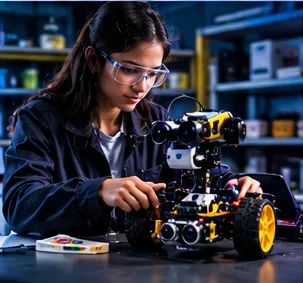
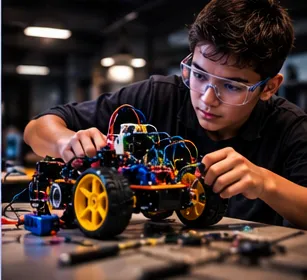
Online STEM education for kids in Strasbourg blends logic, experimentation and creative technology for bilingual and international families who want structured problem-solving practice.
Chapter 130 – K-Means Inertia and Within-Cluster Variation
1. Objective Function
K-Means groups unlabeled points into K clusters by minimizing intra-cluster variance: the total squared distance from each point to its cluster centroid. That sum is called inertia (also WCSS — within-cluster sum of squares).
Inertia = Σ Σ ||xi − μk||². Squaring removes sign and penalizes large distances more strongly.
2. Low vs High Inertia
Low inertia: Points sit close to their centroids — tight, cohesive groups.
High inertia: Points are scattered far from centroids — weak grouping quality.
Training repeatedly shifts centroids to drive inertia down until it stabilizes (convergence) or a max-iteration limit is hit.
3. Outliers and Local Minima
Squared distances make inertia sensitive to outliers, which can pull centroids away from the true cluster core. Random centroid starts can also trap the run in a local minimum. Scikit-Learn’s n_init=10 runs K-Means several times with different seeds and keeps the run with the lowest inertia.
Past the natural K, more clusters always lower inertia a bit but mainly split real groups — diminishing returns and overfitting.
6. Concept Table
Term
Meaning
In Scikit-Learn
Inertia (WCSS)
Sum of squared point–centroid distances
kmeans.inertia_
Centroids
Mean of each cluster
kmeans.cluster_centers_
Convergence
Inertia stops falling
Handled inside .fit()
n_init
Multiple random starts; keep best inertia
KMeans(n_init=10)
Lesson Q&A
Inertia (WCSS) is the sum of squared distances from points to their centroids. Low inertia means compact clusters; high inertia means loose, poorly grouped points. K-Means aims to minimize it.
Squaring distances amplifies far points, so outliers can drag centroids. n_init runs K-Means with several random starts and keeps the lowest-inertia solution, reducing the chance of a bad local minimum.
Inertia fell from ~3720 (K=2) to ~364 (K=3), then only modestly to ~314 and ~274. Beyond the natural cluster count, extra K mostly over-splits groups (overfitting) even though inertia keeps edging down.
What children can learn
Logical problem-solving routines
Linking maths-friendly thinking to coding ideas
Small experiments with clear hypotheses
Communication of results to family or peers
Enquire about online STEM education for kids in Strasbourg
AI and Robotics Club | The 100 Mission AI & Robotics Hero Journey
European Capital Innovators: Fostering Logic and Problem-Solving in Strasbourg
STEM is a habit of testing ideas. Online STEM education for kids in Strasbourg emphasises that habit: form a simple hypothesis, try, observe, revise. Border-city families often value multilingual identity and European outlook. English-medium STEM online can sit alongside French schooling without claiming to replace it.
Activities may include logic puzzles, introductory coding, or carefully framed robotics concepts—matched to readiness after enquiry. We do not publish a fake multi-year diploma track. Parents model curiosity by asking what surprised the child. Mistakes are data.
A one-page hypothesis notebook—question, guess, test, result—turns STEM into a repeatable ritual usable for coding, puzzles or supervised home experiments. Community enrichment—100 Mission playlist and Saturday live support—offers free touchpoints. Formal pathways remain enquiry-based via WhatsApp +92 322 4217059.
Strasbourg’s search intent often mixes European identity with practical after-school learning. Honest online delivery meets that need without inventing local facilities. Online STEM education for kids in Strasbourg is about structured curiosity, not spectacle.
Frequently asked questions
Is STEM learning online effective for Strasbourg families?
Yes, live guided sessions let children practise experiments and logic challenges with mentor feedback from home.
What language are sessions delivered in?
Sessions use clear English suited to international and bilingual households.
How do we ask about suitable starting levels?
Message WhatsApp +92 322 4217059 or email support@aiandroboticsclub.com with your child’s age and interests.