Breadboard to Behaviour: Arduino Practice for BSD City Learners
BSD City families exploring hardware need safe, clear pathways. Simulators first; kits optional. Enquire +92 322 4217059. No invented BSD lab.
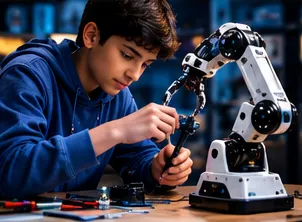
Arduino electronics and robotics projects for BSD City, Tangerang guide students through breadboard wiring, ultrasonic sensing, motor control and introductory C++ logic—simulators first, optional kits under supervision.
Video coming soon
Lesson notes and Q&A below are available now. The video will appear here when published.
In Python, a variable functions as a storage box or container held in computer memory to store data, with a label placed on the box representing its variable name. The data held inside is called a “variable” because its value can vary or change throughout the life of a program.
In Python, you do not need to explicitly declare a data type beforehand. Whenever you assign data to a variable, Python automatically inspects the assigned value and determines its data type dynamically.
Topic 12 introduces the four foundational data types used across Python programs:
| Type | Description | Examples |
|---|---|---|
| Integer (int) | Whole numbers | 25, 7, -5 |
| Float (float) | Decimal numbers | 3.5, -8.5 |
| String (str) | Text, letters, symbols | "Ali Zafar" |
| Boolean (bool) | Binary flags | True or False |
# Creating an integer variable
age = 25

# Displaying the value
print(age)
Output:
25score = 3.5
print(score)
print(score + 1)name = "Ali Zafar"
print(name)
message = name + " is good"
print(message)is_passed = True
print(is_passed)
is_passed = False
print(is_passed)score = 3.5
print(type(score))A string is a collection of characters. The + operator concatenates strings (e.g., "Ali Zafar" + " is good" → "Ali Zafar is good").
A Boolean holds only True or False. Use type(variable) to inspect any variable’s data type.
mBlock Coding for Kids on Udemy.
Disclosure: This page contains affiliate links. We may earn from qualifying purchases at no extra cost to you. Links are intended for parents and educators, not as marketing directed at young children.
BSD City families exploring hardware need safe, clear pathways. Simulators first; kits optional. Enquire +92 322 4217059. No invented BSD lab.
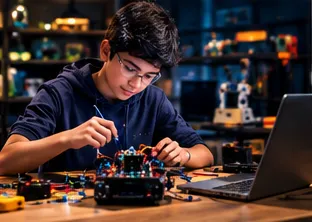
Students learn breadboard circuit wiring, C++ microcontroller coding, ultrasonic distance sensors, and motor control. Expat and local students in BSD City can either use web-based circuit simulators during live sessions or order physical starter kits delivered to their Tangerang address.
By building tangible sensor-guided devices, students gain real-world prototyping experience that strengthens their analytical capabilities and complements international school STEM syllabi.
Simply send a WhatsApp message to our lead mentor detailing your child’s age and current experience level to claim a free 1-on-1 trial class pass.