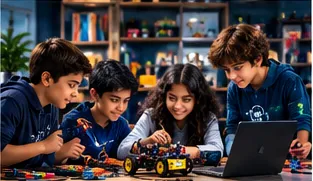
STEM robotics workshops for kids in Liberec introduce practical engineering ideas—gears, torque, conductivity and sensor reflections—through guided online projects.
Chapter 120 – K-Nearest Neighbors (KNN) Explained
1. What Is KNN?
K-Nearest Neighbors is a simple supervised algorithm for classification and regression. Its idea is "birds of a feather flock together": a new point is labeled by looking at its closest neighbors in feature space.
Lazy learner: no fitted equation or weights—training data stays in memory and is queried at prediction time.
Explainable: every decision can be traced to the actual neighbors used.
Dual use: majority vote for classes; mean of neighbor targets for continuous values.
2. Advantages and Uses
Easy to understand; non-parametric (no distribution assumptions).
Works with mixed numerical and categorical features when distances are defined carefully.
Examples: handwritten digit recognition; house price estimates from similar nearby properties.
3. Four-Step Workflow
Choose k — usually an odd number for classification to avoid ties (e.g. 3, 5, 7).
Compute distances from the query to every training point (Euclidean or Manhattan).
Sort distances and keep the top-k nearest neighbors.
Predict — majority vote (classification) or mean of targets (regression).
It does not learn parameters; it keeps the training set and compares a new point to stored examples at inference. Predictions are explained by the actual neighbors and their labels or values—"birds of a feather flock together."
Odd k (3, 5, 7…) avoids 2–2 style ties in majority vote. Distances are usually Euclidean (straight-line) or Manhattan (sum of absolute coordinate differences).
Classification: majority vote among the k neighbors. Regression: mean of the k neighbors' continuous target values (e.g. average of three nearby house prices).
What children can learn
Gear ratios and motor torque ideas
Electrical conductivity basics
Sensor wave reflections
CET-aligned session options on enquiry
Enquire about STEM robotics workshops for kids in Liberec
Recommended self-paced course for parents & educators
Maths for Future Coders on Udemy — a structured option families can explore alongside live mentoring.
Disclosure: This page contains affiliate links. We may earn from qualifying purchases at no extra cost to you. Links are intended for parents and educators, not as marketing directed at young children.
Practical Engineering Labs: Hands-On Science and Electronics in Liberec
Liberec workshops link physics ideas to digital behaviour. Online is primary; CET slots on enquiry. Hardware needs supervision. Contact support@aiandroboticsclub.com or WhatsApp +92 322 4217059. No invented Liberec campus.
Parent guidance
Ask your child to explain one idea in their own words. Prefer guiding questions over completing the work for them. Supervise online accounts and any hardware.